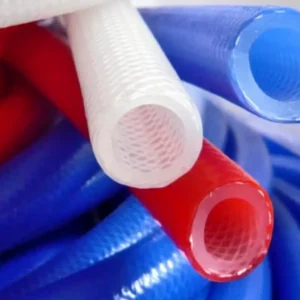
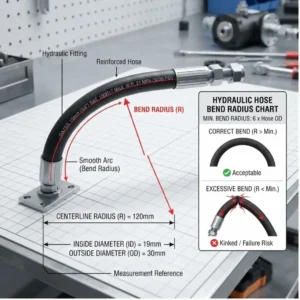
Understanding hydraulic hose flow and velocity is critical not only to system efficiency but also to its health and longevity. It’s not enough to simply connect a pump to an actuator; how fast the hydraulic fluid flows through the hose can directly impact pressure drop, heat generation, and even component life. Getting the flow and velocity wrong can lead to cavitation, premature wear, and wasted energy, which can seriously impact system performance.
This guide will dive into the principles of hydraulic hose flow and velocity, explain how they relate to each other, and provide practical tips for calculating and managing them effectively. My goal is to equip you with the knowledge to design and maintain hydraulic systems that operate at peak efficiency, minimize common problems, and maximize productivity.
Importance of Optimizing Flow and Velocity in Hydraulic Hose
Optimizing flow and velocity in hydraulic hoses is crucial for system efficiency, safety, and longevity. Proper management reduces wear, prevents pressure drops, and ensures consistent performance. Understanding the effects of flow and velocity helps avoid costly downtime and equipment damage.
Key benefits include:
- Enhanced System Efficiency: Proper flow and velocity allow hydraulic systems to operate smoothly, reducing energy losses and improving overall performance. By matching hose size and type to system requirements, fluid moves efficiently, minimizing turbulence and friction, which leads to better response times and lower operational costs.
- Reduced Wear and Damage: Controlling flow velocity prevents excessive stress on hoses and fittings, reducing the risk of leaks, bursts, and premature failure. Consistent fluid movement limits internal erosion and abrasion, extending hose life and protecting pumps, valves, and other hydraulic components.
- Improved Safety and Reliability: Correctly sized hoses with optimized flow reduce the likelihood of accidents caused by hose failure. Maintaining stable velocity ensures predictable system behavior under varying loads, supporting safe, reliable operation in industrial, automotive, and heavy machinery applications.
What is Hydraulic Hose Flow Rate?
Hydraulic hose flow rate refers to the volume of fluid that moves through a hose within a specific time, usually measured in gallons per minute (GPM) or liters per minute (LPM). Understanding flow rate is essential for proper hose selection, system efficiency, and preventing damage caused by excessive pressure or turbulence.
- Definition and Measurement: Hydraulic hose flow rate is the amount of fluid passing through a hose per unit of time. Measuring flow rate ensures that the hose can handle the system’s requirements, preventing underperformance or strain. Accurate calculations help maintain efficiency and prevent system overload.
- Impact on System Performance: Proper flow rate ensures smooth and predictable operation of pumps, valves, and actuators. If the flow rate is too low or too high, it can cause pressure drops, cavitation, or turbulence, reducing overall hydraulic system efficiency and lifespan.
- Role in Hose Selection: Knowing the flow rate helps determine the correct hose diameter, material, and reinforcement type. Selecting a hose suited to the system’s flow prevents leaks, bursts, and premature wear, ensuring safety, reliability, and optimal performance in industrial and mobile hydraulic applications.
What is Hydraulic Fluid Velocity?
Hydraulic fluid velocity refers to the speed at which fluid flows through a hose, typically measured in feet per second (fps) or meters per second (m/s). Maintaining proper velocity is essential to prevent hose wear, minimize pressure loss, and ensure safe, efficient hydraulic system performance. Key considerations include:
- Definition and Measurement: Hydraulic fluid velocity is the rate at which fluid travels inside a hose. Measuring velocity helps engineers and operators ensure the system operates within safe limits, preventing excessive stress on hoses, fittings, and components while maintaining consistent flow and performance.
- Impact on System Efficiency: Proper fluid velocity reduces turbulence, friction, and pressure drops in hydraulic systems. High or low velocities can cause cavitation, erosion, and inefficient operation, decreasing overall system efficiency and potentially leading to costly maintenance or unplanned downtime.
- Importance in Hose Selection: Understanding fluid velocity helps determine the correct hose diameter and material. Selecting hoses that accommodate the desired velocity minimizes wear, extends service life, and ensures reliable performance in industrial, automotive, and mobile hydraulic applications.
How Hose Size Impacts Velocity?
Hose size directly affects hydraulic fluid velocity, influencing system performance, pressure, and wear. Choosing the correct diameter ensures optimal flow, reduces turbulence, and prevents damage to hoses and components.
Understanding this relationship helps maintain efficiency, extend hose life, and improve safety in hydraulic systems. Key points include:
- Smaller Hose Diameter Increases Velocity: Using a hose with a smaller diameter increases fluid velocity, which can lead to higher friction, turbulence, and heat buildup. Excessive velocity may accelerate hose wear, cause pressure spikes, and reduce system efficiency, potentially damaging pumps, valves, and other hydraulic components.
- Larger Hose Diameter Reduces Velocity: A larger hose diameter lowers fluid velocity, minimizing friction and energy loss. Slower velocity reduces stress on the hose and fittings, preventing premature wear and maintaining consistent system performance. However, oversizing can lead to slower system response and higher material costs.
- Balancing Hose Size and System Needs: Selecting the right hose size requires balancing velocity, pressure, and flow requirements. Properly sized hoses optimize efficiency, reduce maintenance, and ensure safe, reliable operation across industrial, automotive, and mobile hydraulic systems without compromising performance or durability.
Recommended Velocity Ranges (General Guidelines)
Based on industry best practices and my own experience, here are some general guidelines for optimal fluid velocity in various parts of a hydraulic system:
| Circuit Section | Recommended Velocity (ft/s) | Recommended Velocity (m/s) | Considerations |
| Suction Lines | 2 to 4 | 0.6 to 1.2 | Avoid cavitation; minimize pressure drop at pump inlet. |
| Pressure Lines | 10 to 20 | 3 to 6 | Balance pressure drop, heat generation, and response time. |
| Return Lines | 4 to 15 | 1.2 to 4.5 | Minimize pressure drop back to reservoir; avoid excessive back pressure. |
| Actuator Lines | 10 to 20 (can vary) | 3 to 6 (can vary) | Minimize pressure drop back to the reservoir; avoid excessive back pressure. |
How to Calculate Hydraulic Hose Velocity?
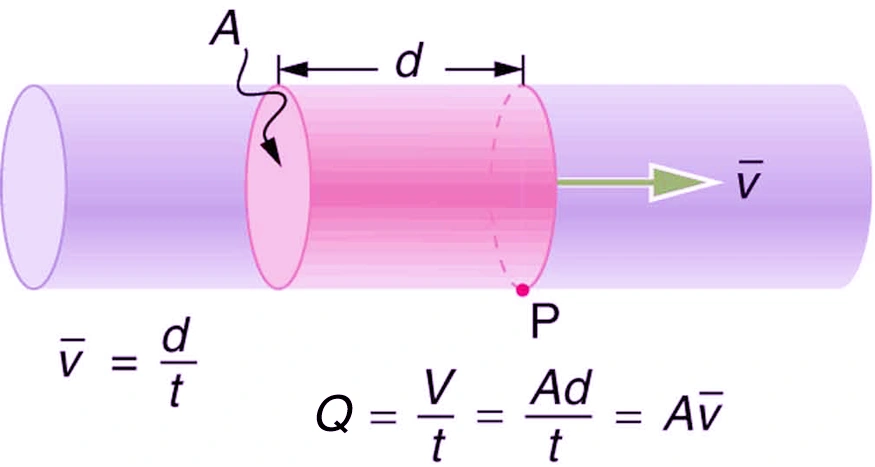
To ensure you’re within these optimal ranges, you need to be able to calculate hydraulic hose velocity. The formula is straightforward once you have the necessary values.
The basic formula for fluid velocity is:
V=AQ
- V = Velocity
- Q = Flow Rate
- A = Cross-sectional Area of the hose’s inner tube
However, since hoses are typically round, we can derive a more practical formula using the hose’s internal diameter (ID).
Formula for Imperial Units (GPM, Inches, ft/s):
V (ft/s)=ID2 (inches2)0.3208×Q (GPM)
- 0.3208 is a constant that converts GPM to cubic feet per second and accounts for the area of a circle.
- Q = Flow rate in Gallons Per Minute (GPM)
- ID = Inside Diameter of the hose in inches
Formula for Metric Units (LPM, mm, m/s):
V (m/s)=ID2 (mm2)21.22×Q (LPM)
- 21.22 is a constant that converts LPM to cubic meters per second and accounts for the area of a circle.
- Q = Flow rate in Liters Per Minute (LPM)
- ID = Inside Diameter of the hose in millimeters
Practical Example: Calculating Pressure Line Velocity
Suppose we have a hydraulic system:
- Flow Rate (Q) = 20 GPM
- Hose Internal Diameter (ID) = 0.75 inches (3/4 inch hose)
Using the imperial formula: V=0.7520.3208×20 V=0.56256.416 V≈11.41 ft/s
Referring back to our table, 11.41 ft/s falls within the recommended 10 to 20 ft/s range for pressure lines. This tells us the hose size is appropriate for this flow rate.
Consequences of Incorrect Hydraulic Hose Flow and Velocity
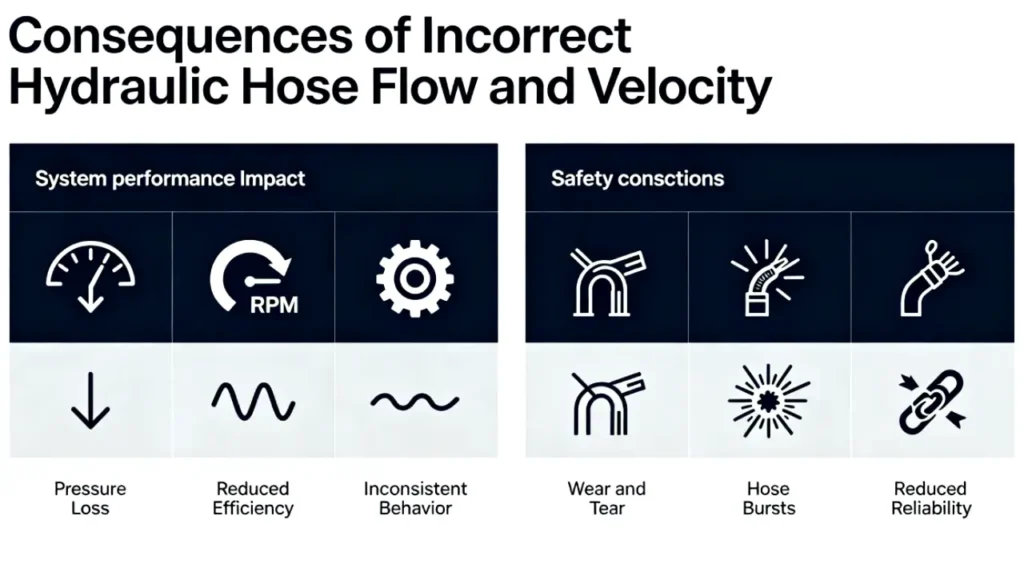
Hydraulic hose flow and velocity play a critical role in the performance, safety, and longevity of hydraulic systems. Incorrect flow or velocity can lead to inefficiencies, excessive wear, unpredictable behavior, and even safety hazards. Understanding the consequences helps operators select the right hoses, optimize system performance, and prevent costly downtime or equipment failure.
System Performance Issues
Incorrect hydraulic hose flow and velocity can severely impact system performance, causing inefficiencies, pressure drops, and inconsistent operation. Understanding these consequences helps operators and engineers take preventative measures to maintain system reliability and reduce costly downtime. Key issues include:
- Pressure Loss and Turbulence: Excessive or insufficient flow velocity can cause pressure drops and turbulence, reducing system efficiency. This disrupts smooth operation of pumps, valves, and actuators, leading to slower response times and decreased productivity in both industrial and mobile hydraulic applications.
- Reduced Efficiency: When flow and velocity are not optimized, energy is wasted, and components work harder than necessary. This can increase operational costs and strain equipment, lowering overall hydraulic system efficiency while reducing the lifespan of hoses and other components.
- Inconsistent System Behavior: Incorrect flow may result in unpredictable system responses, such as jerky movements or delayed actuation. These inconsistencies compromise precision and reliability, making operations less safe and potentially causing damage to both machinery and products.
Safety and Hose Longevity Concerns
Improper hydraulic hose flow and velocity also affect safety and hose lifespan. Mismanaged systems can lead to leaks, bursts, and component failures. Being aware of these risks is crucial for operators who want to protect personnel, equipment, and investments. Key concerns include:
- Increased Wear and Tear: High fluid velocity or pressure spikes accelerate hose abrasion, weakening the structure over time. Repeated stress can lead to cracks, leaks, or complete hose failure, necessitating frequent replacements and increasing maintenance costs.
- Risk of Hose Bursts: Excessive flow or velocity can exceed a hose’s pressure rating, causing sudden bursts. This not only halts operations but also poses serious safety hazards, including fluid injection injuries, equipment damage, and potential downtime for repairs.
- Reduced Safety and Reliability: Hoses that operate outside recommended flow and velocity ranges compromise system reliability. Unsafe conditions may arise, endangering personnel and equipment, while unpredictable system behavior can lead to costly accidents or unplanned maintenance.
Practical Tips for Managing Hydraulic Hose Flow and Velocity
As a system designer or maintenance professional, you have several levers to pull to ensure optimal hydraulic hose flow and velocity. Here are my top recommendations:
- Size Hoses Correctly from the Start: This is the most crucial step. Use the velocity formulas and recommended ranges during the design phase. Don’t simply use the same size hose as the port on the pump or valve; verify it for your specific flow rate.
- Consider Different Hose Sizes for Different Lines: As shown in the velocity table, suction lines typically require larger IDs than pressure lines to prevent cavitation, while return lines might be sized slightly larger than pressure lines to minimize back pressure.
- Minimize Hose Length and Bends: Every foot of hose and every bend introduces friction and pressure drop. Route hoses as directly as possible with the fewest and largest radius bends permissible.
- Select the Right Fittings: Ensure that fittings have an adequate internal bore size. Restrictive fittings can act as bottlenecks, causing localized high velocity and pressure drops, negating the benefits of correctly sized hoses.
- Regularly Monitor System Performance: Pay attention to system temperature, noise levels, and actuator speed. Sudden changes can indicate issues with fluid flow or velocity, potentially stemming from a hose problem.
- Maintain Fluid Cleanliness: Contaminants accelerate hose erosion at any velocity. Good filtration practices are paramount.
- Consult OEM Specifications: Always refer to the original equipment manufacturer’s (OEM) guidelines for specific velocity recommendations for their machinery, as these may be optimized for their particular components.
Conclusion
Understanding hydraulic hose flow and velocity is essential for maintaining system efficiency, safety, and longevity. Properly managing these factors helps prevent hose wear, pressure drops, and component damage, ensuring reliable performance in industrial, automotive, and mobile hydraulic systems. Selecting the right hose size and type plays a crucial role in achieving optimal results.
For durable hydraulic hoses, trust Gushan Rubber for your wholesale needs. Whether you require stainless steel, PTFE, or synthetic braided hoses, we offer a wide range of options to meet your system requirements. Contact Gushan Rubber today to get the perfect hydraulic hoses for your project.